

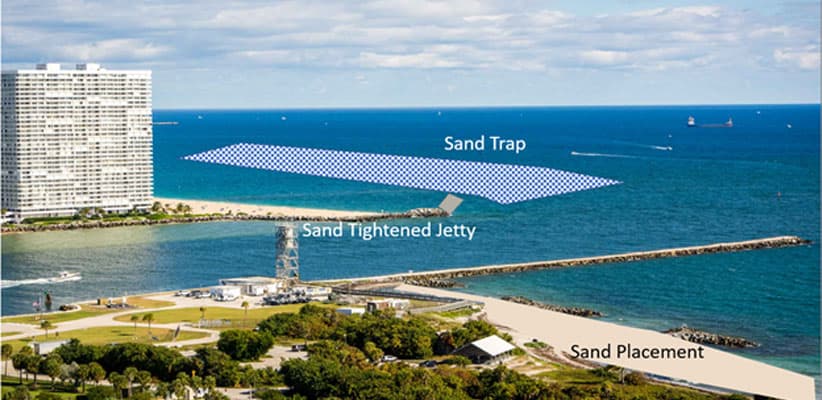
Advocacy groups say they plan to sue the U.S. Army Corps of Engineers and the National Marine Fisheries Service, alleging violations of the Endangered Species Act related to the Port Everglades Inlet Sand Bypass Project.
In a 60-day notice of intent to sue, organizations including the Center for Biological Diversity, Miami Waterkeeper, the Florida Wildlife Federation and the Diving Equipment and Marketing Association (DEMA) argue that federal agencies failed to properly reinitiate consultation under the Endangered Species Act after what they describe as project changes and new information about environmental impacts.
The groups say the project is producing larger-than-expected sediment plumes that may be harming nearby reef systems, including threatened staghorn coral and queen conch populations. They also point to a 2023 marine heatwave that already stressed coral populations in the region, saying additional sediment impacts could increase risks to survival.
“The reef around Port Everglades holds some of the last surviving corals of their kind in Florida. For reasons we still don’t fully understand, they are hanging on here — and that makes the stakes of this dredging project extraordinarily high,” said Rachel Silverstein, CEO and Waterkeeper at Miami Waterkeeper in a press release. “Unfortunately, we are already seeing warning signs that echo the PortMiami dredging disaster, where massive sediment plumes devastated reefs that were never restored. We are calling for commonsense safeguards, science-based oversight, and stronger mitigation before more of these irreplaceable reefs are lost.”
The notice also alleges that federal agencies relied on biological opinions that the groups describe as outdated or inconsistent with current conditions, and claims the project may be causing unauthorized impacts to protected coral species.
“Staghorn coral are clinging to survival in Florida, with some of the very last healthy populations living near Port Everglades. This project threatens these vulnerable corals right at the moment they need the most protection and threatens to cause far more damage to the reef than federal agencies anticipated,” said Danika Desai, senior attorney with Earthjustice in a press release. “We plan to sue to prevent the project from causing even more damage and to protect threatened coral and queen conch from further harm.”
The Port Everglades Inlet Sand Bypass Project, located in Broward County, is designed to move sand that accumulates along the inlet to help maintain beach nourishment and reduce erosion. County officials say the work is intended to restore natural sand flow disrupted by the inlet and protect surrounding beaches and infrastructure.
Broward County said it worked with state and federal scientists throughout the permitting process and that corals, sea urchins and queen conch were relocated from the construction area before work began.
“The Port Everglades Sand Bypass Project is showing evidence of sediment impacts beyond the federal agencies' initial predictions, which could cause greater harm to the Staghorn coral and queen conch located near the Project area. The destruction of this biologically important reef is also inflicting direct, measurable economic harm to South Florida’s dive, snorkeling and fishing industries,” said Nicole Russell, interim president and CEO of DEMA in a press release. “The harmful sediment from the project, which obscures light and limits visibility so necessary to a healthy reef, is also causing the potential loss of millions of dollars in direct, annual economic output from these small family-owned businesses, including the loss of thousands of jobs."
Construction on the project is expected to continue through 2029, according to county information.
The Center for Biological Diversity said more than 35,000 people signed a petition calling on regulators to stop the Port Everglades expansion project. The group said the U.S. Army Corps of Engineers has withdrawn its state permit application for the expansion dredging work, while a separate dredging project is already underway. It also said the agency is reconsidering elements of the proposal, which could lead to changes in its scope.
At this time, the Tampa Bay Observer is waiting on a statement from the U.S. Army Corps of Engineers.