

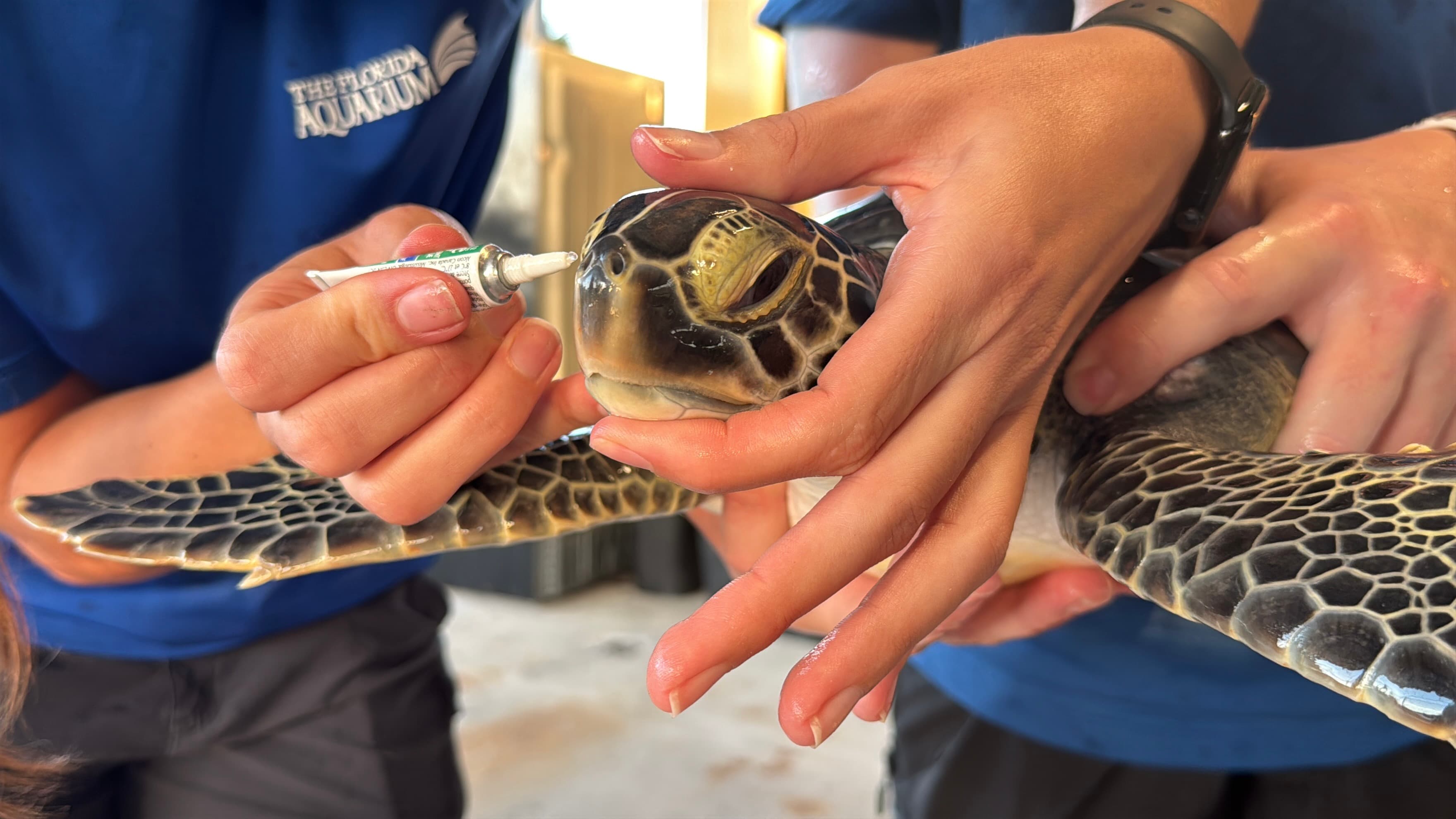
Four juvenile green sea turtles returned to the Atlantic Ocean on Aug. 11 after months of intensive rehabilitation at The Florida Aquarium's Sea Turtle Rehabilitation Center.
The four turtles, named Dark Blue Yellow, Pink, Black and Light Blue Pink, were released together near Palm Coast.
Dark Blue Yellow was stranded on March 29 at Minerva Beach after suffering a severe gash across the underside of its shell, one of the most serious wounds the Aquarium's team has successfully treated.
"When we initially got Dark Blue Yellow, it was initially for cold-stunned treatment, so we didn't expect to find this large gash on the underside of the shell," said Alyssa Fessett, The Florida Aquarium’s Sea Turtle Rehabilitation Center manager. "The fact the turtle was alive with this level of a wound was surprising."
Fessett said the care team used a specialized topical ointment that creates a waterproof barrier over the wound to help support the healing process. The turtle also received antibiotics, X-rays, honey and other topical treatments. With every week, Fessett said the wound tissue was filling the space.
"An unfortunate thing within our field of care is that when we see really bad wounds, we've seen really severe ones that lead to either euthanasia or the turtle doesn't make it. So this one being so severe but having a positive outcome was really amazing," Fessett said.
Pink, Black and Light Blue Pink were rescued throughout March off Florida's east coast after being cold-stunned.
"There are two types of cold stunning we see. There is acute cold stunning that happens quickly and the turtle becomes lethargic and needs to be slowly warmed," Fessett said. "We specialize in chronic cold stun and they have developed secondary infections or pneumonia and they become underweight. This can take anywhere from three months to a year to treat depending on what illness the turtle has."
When treating cold-stunned turtles, the care team gives each turtle its own specialized care that involves fluids, antibiotics, calcium supplements, a proper diet to gain weight and enrichment tools to encourage natural behavior before they are released.
"Even though they come in similar times or for the same reason, each turtle gets specialized treatment and types of enrichment activities," Fessett said.
Aquarium officials said the four turtles completed their exit examinations within the past two weeks and were determined to be healthy for release. Each turtle's treatment cost around $15,000.
"While it could be much easier to release them by our facility, it is important to put them back where FWC designates. This helps track the populations," Fessett said. "Turtles do migrate and we can see them move up and down coasts by satellite tracking, but the goal is to keep the populations stable where they are."
While these four turtles have returned to the Atlantic Ocean, four juvenile green sea turtles will remain at the Sea Turtle Rehabilitation Center receiving treatment until they are cleared for release.
If you encounter an injured sea turtle, do not touch it. Contact the FWC Hotline at 888-404-3922 immediately to ensure the turtle is taken to the proper care facility for rehabilitation.