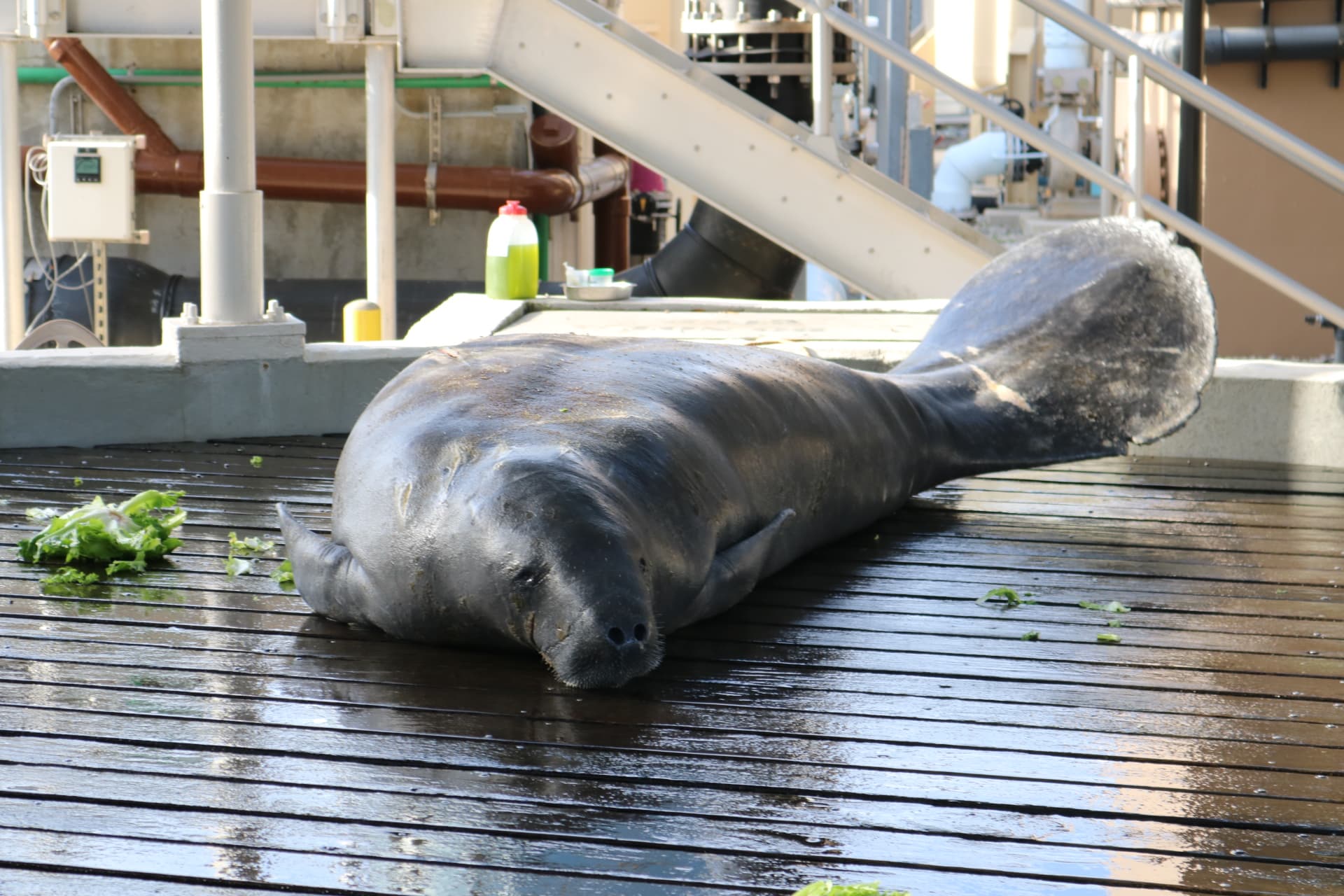
Nearly 2,000 Florida manatees have died in the past two years, prompting conservationists to push federal officials to list Florida manatee as endangered under the Endangered Species Act (ESA).
“There was a significant die-off a few years ago along the coast of the Indian River lagoon where more than 2,000 manatees died due to water pollution over the years, " said Elise Bennett, the Florida and Caribbean Director for the Center for Biological Diversity.
Bennett said manatees are struggling to find sea grasses to eat during the colder months, when they are refueling and gaining their energy back.
Reproduction rates have also dropped. Bennett said wildlife officials are not seeing the same survival rates in calves as in previous years.
“The manatee is currently listed as a threatened species, even though these ongoing die-offs indicate that it is in fact, endangered,” Bennett said. “We also have a presidential administration that’s working to roll back the ESA protections for all species and that includes the manatee.”
Pollution is one of the biggest contributors to manatees deaths, along with boating strikes. Bennett said Florida has not done enough to control agricultural runoff, failing septic systems and urban run-off pollution.
“We need to be pushing our legislators for more and stronger regulations on water quality, especially when it comes to our septic tanks and run off from agriculture facilities. As individuals we need to stop or use less fertilizers on our lawns,” Bennett said.
Boat strikes are the leading human-cause of deaths for manatees. More than 100 manatees die each year on average from vessel collisions, Bennett said.
“Drive more slowly, especially in areas where the water is more shallow and areas where we know manatees are often using the area,” Bennett said. “There are some education materials about manatee signs and conservation that’s part of getting your boater license.”
Boaters can spot manatees by looking for circular “boiling” patterns, also known as “footprints,” in the water, created by their tails moving just below the surface.
The Center for Biological Diversity said it’s fearful that the population of Florida manatees will continue to decline due to the environmental degradation and human impacts. The group argues the 2017 decision to reduce protections came despite warnings from experts about declining water quality and seagrass loss.
“This change in status suggested the manatees were doing better and in some ways they were, but at the time experts told the agency that due to poor water quality sea grass would collapse,” Bennett said. “A few years later there was a massive die-off.”
Bennett said The Center for Biological Diversity submitted a formal petition to up-list the manatees from threatened to endangered. The U.S. Fish and Wildlife Service denied endangered protection for Florida manatees in 2025.
“We have submitted more science urging them to reconsider and there’s still time before they finalize their decision,” Bennett said.
The formal petition is a scientific and legal document that starts the formal process for the wildlife agency to consider increasing protections under the ESA.
Several groups signed onto the petition, including Harvard Animal Law and Policy Clinic, Miami Waterkeeper, Save the Manatee Club and an individual named Frank S. Gonzalez Garcia on behalf of the Antilean Manatees in Puerto Rico.
The Center for Biological Diversity also launched an action alert encouraging Floridians to submit public comments in support of stronger protections. More than 14,520 comments were submitted through the effort, Bennett said.
An endangered species is defined as one that is in danger of extinction throughout all or a significant portion of its species. A threatened species is one that is likely to become endangered in the foreseeable future. When a species is downlisted from endangered to threatened, states may loosen certain regulatory requirements.
“By failing to list Florida manatees as endangered, it’s not recognizing that our manatees are in trouble and they need extra help from the state and federal government. They need extra help from individuals by boating more safely, by taking care of water quality, by not using so many fertilizers, all the different ways that an individual can help,” Bennett said. “That listing is a warning sign that we should be doing more.”
However, The U.S. Fish and Wildlife service agreed and proposed to protect a couple million acres of habitat for the species based on specific criteria such as warm water, sea grass and good water quality.
Those protections are awaiting approval and Bennett said they are way overdue. Bennett said, Legally the U.S. Fish and Wildlife Service has a year to finalize protection after the proposal.
“The final protections were due Sept. 23, 2025. So they’re nearly six months overdue at this point,” Bennett said.
She does not fully blame the agency for this delay as she said they have faced severe cuts in staff and funding during the Trump Administration.
In a statement by the U.S. Fish Fish and Wildlife Service spokesperson, “The Service works closely with partners to conserve and protect manatees, and there is no current proposed or previously finalized rule to remove them from federal protection under the Endangered Species Act. In 2017, we found that the West Indian manatee population was steady or growing slowly, and that current threats were under control. Because of this, “threatened” was a more accurate status than “endangered.” In Florida today, scientists estimate there are at least 8,350 manatees, far more than the 1,267 to 2,630 estimated in the 1990s. The best available science always drives our decision-making, and we are committed to ensuring the protection and recovery of both subspecies of manatees.”
Bennett said the center will continue to push for more protection for the manatees, but for now she said the best way to support manatee protection is to contact lawmakers, advocate for stronger environmental policies and educate neighbors on how to safely coexist with the iconic marine mammals.